Hack Stash
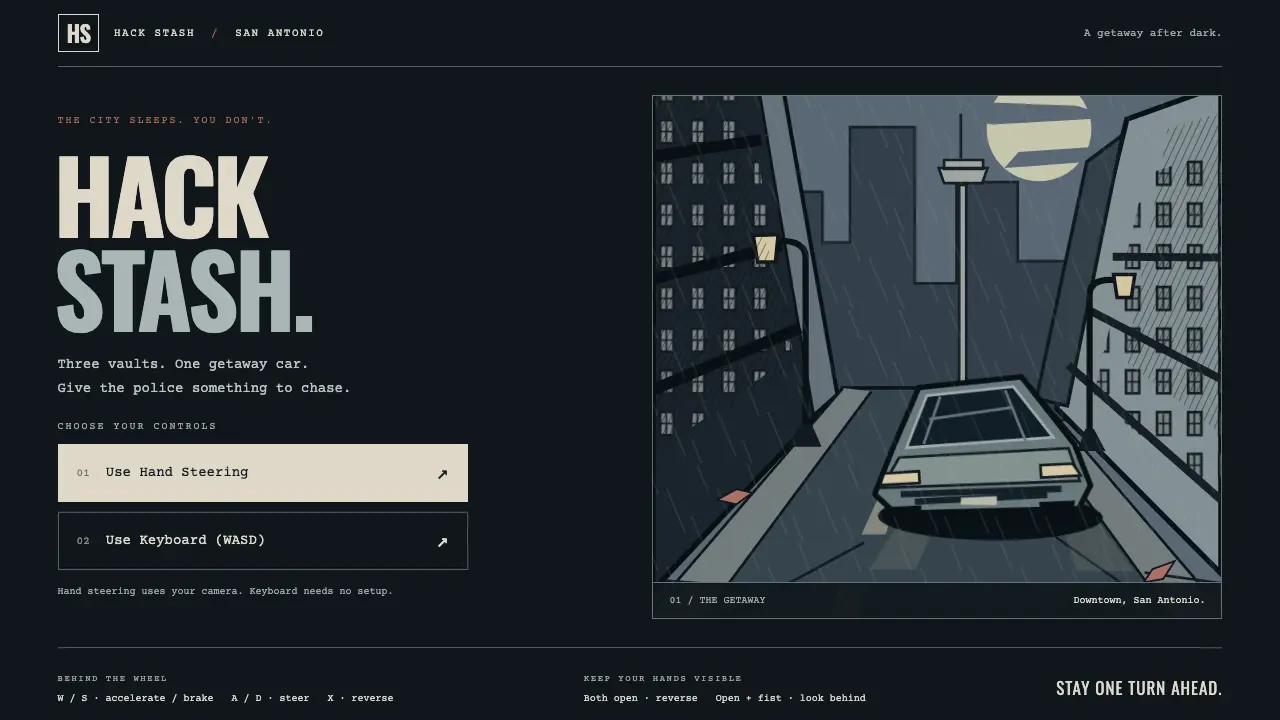
A getaway driving game through downtown San Antonio, steered with your hands, where each landmark vault opens a challenge on real hardware or a phone call.
- Role
- Team of 4, RowdyHacks 2026. My part: the Alamo vault challenge (Arduino and Raspberry Pi relay, servo, LCD, sensor protocol, server logic and tests), the Render and Vercel deployment, and the architecture diagram.
- Stack
Problem
We wanted a heist game that used real San Antonio streets, needed no controller, and spilled out of the browser: each landmark vault opens a challenge on physical hardware or a real phone call.
What I built
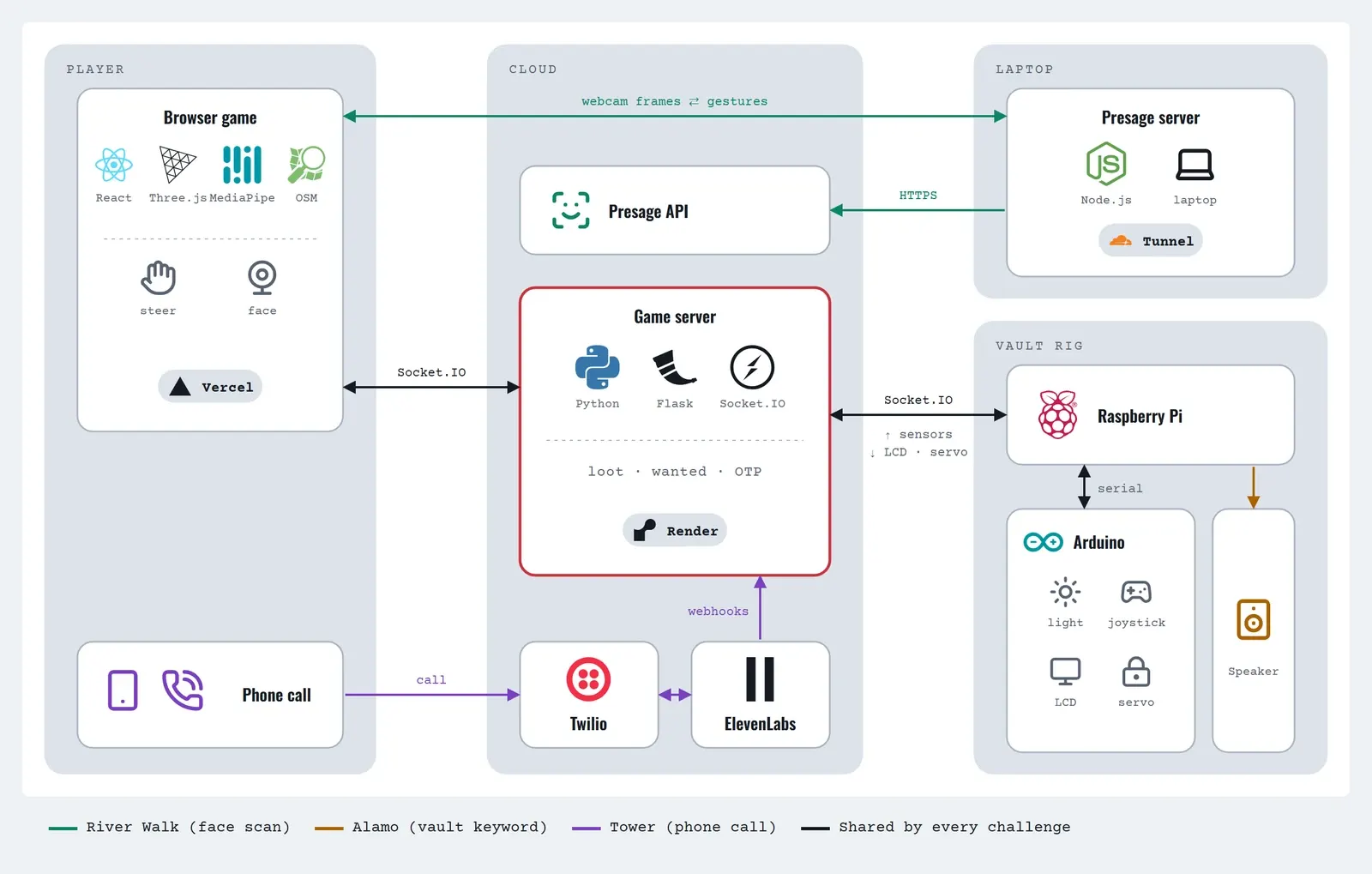
The game: a React Three Fiber city built from OpenStreetMap, MediaPipe hand steering, and a police car that chases you on the same A* road graph used for navigation. Jagadeep Kalluri built the driving game; Ishita Saran built the Riverwalk face-scan challenge, and Dhivyesh Prithiviraj the Tower of the Americas phone-call challenge.
My part was the Alamo vault, end to end: a Simon-says puzzle against a physical rig, where a Raspberry Pi relays an Arduino’s light sensor, joystick, LCD and vault-door servo to the Flask-SocketIO game server. I wrote the relay, the sensor protocol, the server logic and its tests.
I also set up the Render and Vercel deployment and drew the architecture diagram.
Results
- Top committer on the repo (41 of 94 commits).
- The driving game is live. The vault challenges needed the game server and hardware, which ran on-site, so the hosted version shows “heist server offline” inside each challenge.